CCTV Camera Buying Guide for Nairobi Apartments (2026)
Security cameras have become a standard fixture in Nairobi apartment blocks — and for good reason. Whether you manage a 10-unit building in Kilimani or a 60-unit estate in Parklands, a well-designed CCTV system deters criminal activity, supports incident investigations, and gives residents visible proof that their building takes security seriously.
However, choosing the right system is not as simple as buying the cheapest cameras available. Resolution, night vision technology, recording infrastructure, storage capacity, and weatherproofing all affect whether your investment delivers usable footage when you actually need it. This guide covers everything property managers and building owners in Nairobi need to know before buying.
Why CCTV Matters Specifically for Apartments
Unlike standalone homes, apartment blocks have multiple shared spaces — lobbies, stairwells, car parks, perimeter walls, and service entrances — each with different surveillance requirements. A camera suitable for a bright lobby will underperform in a poorly lit basement car park. Understanding those differences before purchasing saves money and avoids a system that looks impressive but captures unusable footage at night.
Additionally, in the event of a security incident, police in Kenya increasingly request CCTV footage as part of their investigation process. Footage that is blurry, overexposed, or already overwritten because storage ran out has no evidentiary value. Getting the specification right from the start is therefore not just a comfort decision — it is a practical one.
Step 1: Understand the Two Main Camera Technologies
Analogue (HD-TVI / AHD / HD-CVI)
Analogue cameras transmit video over coaxial cable to a Digital Video Recorder (DVR). Modern analogue systems support resolutions up to 4K (8MP), making them significantly better than the legacy CCTV systems many Nairobians associate with blurry footage.
Advantages:
- Lower cost per camera compared to IP systems
- Simpler to install on existing coaxial cabling in older buildings
- DVRs are straightforward to configure
Limitations:
- Each camera requires a direct cable run to the DVR
- Smart analytics (facial detection, licence plate recognition) are limited compared to IP
IP (Network) Cameras
IP cameras transmit compressed video over Cat5e/Cat6 network cable to a Network Video Recorder (NVR). They generally offer higher image quality, greater flexibility for camera placement, and access to AI-based analytics.
Advantages:
- Higher resolution at lower bitrates — a 4MP IP camera typically outperforms a 4MP analogue equivalent in low light
- PoE (Power over Ethernet) means a single cable carries both power and data, simplifying installation
- Cameras can be placed anywhere on the network — including on upper floors without long coaxial runs
Limitations:
- Higher cost per camera
- Requires a structured network cabling infrastructure
- NVRs and cameras should ideally come from the same brand to unlock smart features
For new apartment builds in Nairobi: IP cameras with Cat6 cabling are the recommended approach. For existing buildings with coaxial cabling already in place, HD analogue remains a practical and cost-effective upgrade path.
Step 2: Choose the Right Camera Type for Each Location
Different areas of an apartment block require different camera form factors:
| Location | Recommended Camera Type | Key Requirement |
|---|---|---|
| Main entrance / lobby | Dome or turret camera | Wide angle (2.8mm lens), good low-light performance |
| Car park / basement | Dome with colour night vision | Full-colour imaging even at zero lux with white light |
| Perimeter / boundary wall | Bullet camera | Long range IR (30–60m), IP66 weatherproofing |
| Stairwells / corridors | Mini dome | Compact form factor, 1080p minimum |
| Main gate (vehicle) | Bullet or PTZ | High resolution for licence plate capture |
| Lift interior | Fisheye or mini dome | Wide angle to cover full interior |
Step 3: Understand Resolution
Resolution determines how much detail is captured — and whether a face or licence plate is identifiable in footage. The following table outlines the practical differences at common resolutions:
| Resolution | Megapixels | Practical Use |
|---|---|---|
| 1080p | 2MP | Suitable for corridors and indoor spaces where subjects are close to the camera |
| 4MP | 4MP | Recommended minimum for entrances and car parks |
| 4K | 8MP | Required for licence plate capture at distance or wide-area coverage |
For most Nairobi apartments, a combination of 4MP cameras at key external points and 2MP cameras in internal corridors strikes a practical balance between image quality and storage cost.
Step 4: Night Vision — IR vs. Colour Night Vision
This is one of the most important decisions for Nairobi installations, where exterior lighting in residential areas is often inconsistent.
Infrared (IR) Night Vision
The traditional approach. Cameras switch to black-and-white mode at night and use built-in IR LEDs to illuminate the scene. IR cameras are widely available and affordable, but the resulting footage is monochrome — which limits the ability to identify clothing colours, vehicle colours, and other identifying details.
Colour Night Vision (White Light)
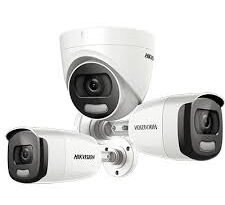
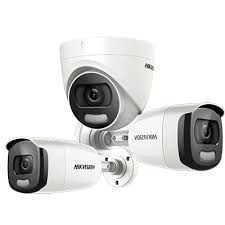
Cameras with built-in white light LEDs (such as Hikvision ColorVu and Dahua Full-Colour series) maintain full-colour recording even in near-darkness. The trade-off is that the white light is visible to anyone in the camera’s view — which can serve as a deterrent, but may not suit all locations.
Starlight / Low-Light Sensors
High-sensitivity image sensors (used in Hikvision DarkFighter and Dahua Starlight series) produce colour footage in very low ambient light without activating white light LEDs. This approach is less obtrusive and performs well in partially lit areas like car parks with minimal overhead lighting.
Recommendation for Nairobi apartments: Use colour night vision (white light) cameras at main entrances and gates for maximum identification capability. Use starlight or IR cameras in corridors, stairwells, and other internal areas.
Step 5: Storage — How Much Do You Need?
Storage is one of the most overlooked aspects of CCTV planning. Running out of storage means the system overwrites old footage before an incident is reported — which is a common and avoidable problem.
Storage requirement depends on three variables: number of cameras, recording resolution, and how many days of footage you want to retain. As a reference point:
- 8 cameras at 4MP, recording 24/7 with motion detection enabled, H.265+ compression will require approximately 2TB of storage for 30 days of footage.
- Increasing to 16 cameras or switching to continuous recording doubles that requirement.
Most professional installers in Nairobi recommend a minimum of 30 days of stored footage for residential buildings. For high-security estates, 60–90 days is preferred.
Storage media: NVRs and DVRs use internal hard drives rated for surveillance use (e.g., Western Digital Purple or Seagate SkyHawk series). Standard desktop hard drives are not recommended — they are not designed for the continuous read/write cycles that CCTV recorders demand.
Step 6: Remote Viewing
Modern NVRs and DVRs support remote access via smartphone apps, which allows property managers and residents to check live footage from anywhere with an internet connection. Hikvision’s Hik-Connect app and Dahua’s DMSS app are the most widely used in Kenya and both support live view, playback, and motion alert notifications.
For reliable remote access in Nairobi, connect the recorder to your router via a wired Ethernet cable rather than Wi-Fi. A stable internet connection — fibre where available — ensures smooth live viewing on mobile data.
Recommended Brands Available in Kenya
Hikvision
Hikvision is the most widely deployed CCTV brand among professional installers in Kenya. Their ColorVu and DarkFighter series address the night vision requirements of Nairobi’s varied lighting conditions, while the AcuSense range reduces false motion alerts triggered by animals or wind. Proftech stocks a full range of Hikvision CCTV cameras and accessories for both IP and analogue systems.
Dahua
Dahua is Hikvision’s closest competitor in Kenya and is often the choice for installations where budget is a priority without sacrificing image quality. Their Full-Colour and Starlight series are well-regarded for low-light performance, and their TiOC (Three-in-One Camera) range combines colour night vision, active deterrence (built-in siren and strobe), and AI analytics in a single unit. Proftech’s Dahua CCTV range covers cameras, NVRs, and supporting accessories.
Uniview
A newer entrant to the Kenyan market but increasingly specified by installers for IP-only projects. Uniview cameras offer competitive image quality at mid-range price points. Proftech also carries Uniview IP CCTV and NVR products for projects requiring an alternative to Hikvision or Dahua.
What Does a Complete System Cost in Nairobi?
Costs vary based on camera count, resolution, whether IP or analogue is used, and installation complexity. As a general reference:
| System Size | Typical Scope | Estimated Installed Cost |
|---|---|---|
| Entry-level (4 cameras) | 4× 2MP analogue, 4-channel DVR, 1TB HDD | KSh 35,000–50,000 |
| Mid-range (8 cameras) | 8× 4MP IP, 8-channel NVR, 2TB HDD | KSh 80,000–120,000 |
| Full apartment block (16 cameras) | 16× 4MP IP with colour night vision, 16-channel NVR, 4TB HDD | KSh 180,000–280,000 |
These figures include supply and professional installation but exclude cabling conduit work, which varies significantly depending on building construction.
Key Questions to Ask Before Installation
Before committing to a CCTV system for your apartment, confirm the following with your supplier:
- Are the cameras and NVR/DVR from the same brand? (Cross-brand mixing often disables smart features.)
- What compression format does the system use — H.264, H.265, or H.265+? (H.265+ reduces storage requirements by up to 75% vs H.264.)
- Is the hard drive rated for surveillance use, or is it a desktop drive?
- Does the system support remote access via a smartphone app?
- What is the warranty period on cameras and the recorder?
- Is installation included, and does it cover cabling and conduit?
Final Thoughts
A CCTV system is only as useful as the footage it produces when an incident occurs. Choosing the right resolution, night vision technology, and storage capacity for your specific building layout — rather than simply buying the most affordable option available — is what separates a system that provides genuine security value from one that merely creates the impression of coverage.
For Nairobi apartments, a combination of 4MP IP cameras with colour night vision at external points and 2MP cameras internally, connected to a 16-channel NVR with at least 2TB of surveillance-grade storage, covers most mid-sized buildings effectively.
Proftech Power Systems supplies and installs Hikvision, Dahua, and Uniview CCTV systems across Nairobi. Call us on 0703 785 219 or email info@proftech.co.ke to discuss the right configuration for your building.