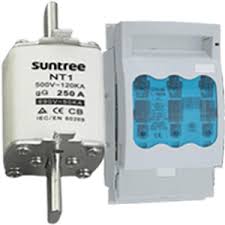

Suntree NH1 250A 1000VDC Battery Fuse – Fuselink, Fusebase and Cover (Single Pole)
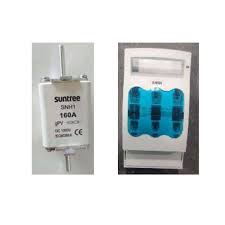
The Suntree NH1 250A is a 250A 1000V DC blade-type battery fuse assembly rated at the upper end of the NH1 format range. It is supplied as a complete single-pole kit comprising a matched fuselink, fusebase, and protective insulating cover — a self-contained DC fuse installation point that requires no additional hardware beyond the DC cables terminated at the base.
At 250A and 1000V DC, the Suntree NH1 250A covers the protection requirements of large commercial hybrid inverters, high-capacity lithium battery banks, and high-current DC distribution busbars. It is the highest-rated single fuselink available in the NH1 blade format, placing it at the boundary where the NH1 format’s physical construction is operating at its current-carrying maximum. Installations requiring protection beyond 250A step up to the physically larger NH2 format.
The NH1 250A fuselink is certified to IEC 60269-6 and GB/T 13539.6, with a short-circuit breaking capacity of 50,000A (50kA) at 1000V DC. The recommended Suntree fuse base for this fuselink is the NH1B single-pole base, which is included in this kit.
NH1 Format at 250A — Upper Boundary of the Size Class
The NH1 blade format is standardised under IEC 60269-2 and DIN 43620. It physically handles a rated current range from approximately 50A to 250A in DC applications, with the 250A being the ceiling. The NH1 format’s ceramic body and blade contact cross-section are engineered to carry this maximum current continuously without excessive thermal stress on the contacts or body, provided the installation environment falls within the rated operating temperature range.
At 250A, the fuse element inside the ceramic body is the widest cross-section silver element in the NH1 form factor. This wide element is necessary to carry 250A with a thermal rise that stays within the rated limits of the base contacts, cable connections, and adjacent switchgear. Consequently, the 250A NH1 is marginally less fast-acting under moderate overload conditions than lower-rated NH1 variants — a direct result of the larger element mass requiring more thermal energy to reach its melting point. This characteristic makes the NH1 250A a good match for inverters and battery banks that produce significant inrush currents during startup or charge/discharge transitions, without nuisance tripping under normal surge conditions.
Fuse Link Construction
The NH1 250A fuselink uses a silver or silver-alloy blade element at maximum NH1 cross-section, enclosed in a high-strength ceramic body packed with chemically processed high-purity quartz sand. The ceramic body and quartz sand medium perform the same arc-quenching function described for all Suntree NH-format fuses: when the element melts, the quartz sand absorbs and disperses the resulting DC arc energy across the length of the fuse body, preventing arc re-strike across the 1000V DC potential.
The fuse operates under the gPV operating class (IEC 60269-6), providing full-range protection against both sustained overloads and short-circuit currents. This distinguishes it from partial-range fuses (designated with the “a” prefix) that protect only against short-circuit currents and rely on other devices to handle overloads.
The 50kA breaking capacity at 1000V DC with a time constant of 1–3ms confirms the NH1 250A can safely interrupt the prospective fault current available from a large lithium battery bank connected in a low-impedance fault — a critical specification for systems where battery banks can deliver tens of thousands of amps into a dead short.
Single-Pole Configuration and the NH1B Fusebase
This assembly is single-pole (1P) — one fuselink, one fusebase position, one set of cable terminations. The single-pole format is appropriate where:
- One conductor per circuit requires protection — typically the positive DC cable of a battery bank or inverter DC input, where system design or local wiring codes call for single-pole fusing
- A single high-current string or feed arrives at a distribution point and requires its own dedicated fuse station with a permanently fixed base
- Individual battery bank protection is required in parallel battery systems where each bank has its own positive cable and dedicated fuse before the common busbar
The NH1B fusebase included in this kit is the Suntree-recommended matching base for the NH1 format fuselink. It provides screw-type cable terminations on each side of the fuse position, rated to accept the large-section cable required for 250A DC circuits. The base is fixed to an enclosure backplate or mounting surface during installation and remains in place permanently — only the fuselink is replaced after a fault operation.
The protective insulating cover clips over the complete assembly after installation, providing touch protection over the live blade contacts and base terminals. At 1000V DC and 250A, inadvertent contact with uncovered live parts carries an extreme hazard; the cover is a non-negotiable part of a safe installation, not an optional accessory.
Sizing and Power Equivalents at 250A
The 250A continuous rating of the Suntree NH1 250A corresponds to the following power levels at common DC bus voltages:
- At 48V DC: 250A × 48V = approximately 12kW — covers commercial hybrid inverters rated 10kW–12kW at this voltage
- At 96V DC: 250A × 96V = approximately 24kW — appropriate for medium commercial off-grid and grid-tied hybrid systems with larger battery banks
- At 120V DC: 250A × 120V = approximately 30kW — large commercial and industrial off-grid installations
For battery string fusing, IEC guidance recommends a fuse rating of approximately 1.25× the maximum continuous discharge current of the battery string. A 250A fuse is therefore appropriate for battery strings with continuous discharge ratings up to approximately 200A — covering large-capacity lithium battery banks with high C-rate discharge capability.