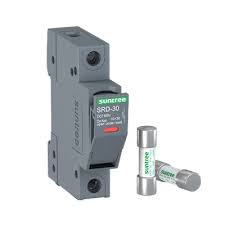
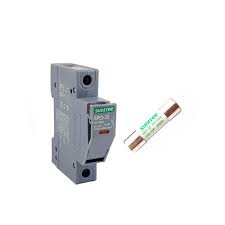
Suntree 30A 1000V DC String Fuse Complete with Holder (SRD-30)
The Suntree SRD-30 is a 30A rated DC fuse and holder assembly designed for overcurrent and short-circuit protection in photovoltaic string arrays. It is rated at 1000V DC and uses a 10×38mm cylindrical fuse link installed in an IP20 single-pole holder — the two components supplied together as a matched, ready-to-install unit.
The SRD-30 series is manufactured by Suntree Electric Group (Zhejiang, China) and certified to IEC/EN 60947-1 and IEC/EN 60947-3, the international standards governing low-voltage switchgear and fusing devices. It carries TUV, CE, and IEC certifications. At 30A, the SRD-30 sits at the upper end of the 10×38mm fuse range and is suited to higher-current PV strings — specifically panels with short-circuit currents (Isc) between approximately 12A and 15A per string.
A key practical feature of the SRD-30 holder is its plug-in fuse design with a visual indicator window. The indicator signals whether the internal fuse link has operated: the indicator light activates when the fuse element has blown, giving installers and maintenance personnel an immediate visual check without requiring a multimeter or removing the fuse from the holder.
Fuse Link Construction
The 30A fuse element within the SRD-30 is a silver or silver-alloy wire chosen for its tight melting tolerances and consistent I²t characteristics. The element is encapsulated inside a high-strength ceramic tube — ceramic rather than glass, for greater mechanical and thermal resistance during high-energy fault interruption. The ceramic tube is filled with chemically processed high-purity quartz sand, which acts as the arc-quenching medium under DC fault conditions.
When a fault current flows, the element melts and the quartz sand rapidly absorbs and disperses the resulting arc energy. This action prevents arc re-strike and contains the interruption entirely within the fuse body. The result is a rated short-circuit breaking capacity of 30,000A (30kA) at 1000V DC with a time constant of 1–3ms — sufficient to interrupt the combined fault current from multiple parallel strings feeding into a single fault point in a DC combiner box.
The fuse operates on the I²t thermal principle: as overcurrent increases, operating time decreases proportionally. This characteristic ensures that sustained low-level overcurrents — such as those caused by insulation degradation or partial ground faults — are also interrupted before cumulative heat damage reaches the wiring or panels.
Holder Design and the Visual Fault Indicator
The SRD-30 holder body is moulded from PA66 flame-retardant material, which self-extinguishes rather than propagating flame under fault conditions. This is a relevant safety consideration for enclosed combiner boxes where multiple fuse holders are installed in close proximity.
The holder uses a plug-in fuse insertion mechanism, allowing the fuse link to be inserted and removed without tools for fast field replacement. This design reduces maintenance time in multi-string combiner boxes where fuse checking is a routine part of periodic system inspection.
The indicator window on the front face of the holder provides a clear blown-fuse signal. When the fuse element operates, the indicator illuminates — removing the guesswork from fault-finding in dense combiner box installations. Technicians can scan the holder row visually to identify a failed string without disturbing each fuse individually.
The holder’s rated insulation voltage (Ui) is 1200V and the rated impulse withstand voltage (Uimp) is 6kV, giving it adequate clearance margins above the 1000V DC operating voltage to handle transient over-voltages from lightning-induced surges or switching events on the DC bus.
Thermal Derating in Enclosed Enclosures
The SRD-30 has a defined derating schedule that governs how the 30A rating must be reduced when multiple holders are installed in the same enclosure. For a single-pole installation at an ambient temperature of 25°C with a cabinet internal temperature of 30°C, the full 30A rating applies (derating factor 1.0). As ambient temperature rises or when more poles are energised simultaneously, the rated current must be reduced:
- At ambient 40°C (cabinet 50°C): derate to 0.9× rated current (27A effective)
- At ambient 50°C (cabinet 60°C): derate to 0.85× rated current (25.5A effective)
For installations with 5–24 poles energised simultaneously — typical in large combiner boxes — the derating is more significant and must be accounted for during system design. This data is important for accurate string fuse selection in high-ambient or large-array installations common in Kenya’s equatorial climate.
Application in PV String Arrays
The 30A rating places the SRD-30 in the correct protection zone for higher-current monocrystalline and polycrystalline panels, including many 400W–600W+ panels that have Isc values approaching 12–15A per string. Standard IEC guidelines specify that string fuse ratings should not exceed 2× Isc. Consequently:
- A string with Isc of 12A requires a fuse rated no higher than approximately 24A → the 25A or 30A SRD-30 is appropriate
- A string with Isc of 15A requires a fuse rated no higher than approximately 30A → the 30A SRD-30 is the correct upper-limit selection
The SRD-30 protects against three primary PV fault conditions:
- Reverse current faults — when a shaded or damaged string in a parallel array becomes a current sink rather than a source, the SRD-30 in that string clears the reverse backfeed before it damages the panels or wiring
- Short-circuit faults — insulation failure, connector damage, or rodent-damaged wiring can create low-impedance faults; the 30kA breaking capacity handles the combined fault current from multiple parallel strings
- Sustained overcurrents — thermal degradation from connector corrosion or loose terminations produces below-threshold overcurrents; the I²t characteristic ensures these are also interrupted before cable or panel damage accumulates
Who Is This Best Suited For?
- Solar installers wiring higher-current PV strings from 400W–600W+ panels where Isc values approach 12–15A. The 30A SRD-30 is the appropriate string fuse for this panel class, where lower-rated 16A or 20A fuses would be under-specified.
- System integrators and EPC contractors building DC combiner boxes for grid-tied commercial arrays. The TUV/CE/IEC certifications and derating table provide the documentation required for system commissioning and insurance compliance.
- Off-grid system designers paralleling high-current strings into battery charge controllers or DC busbars. The matched fuse and holder assembly simplifies bill-of-materials management and ensures holder-to-fuse dimensional compatibility.
- Maintenance technicians servicing existing solar installations. The plug-in fuse mechanism and indicator window make field fault-finding and fuse replacement faster than conventional screw-type holders — particularly useful in combiner boxes with eight or more strings.
- Solar installers in Kenya’s high-ambient environments. The derating table allows correct specification under local temperature conditions, and the –30°C to +70°C operating range covers the full range of Kenyan installation sites from coastal to highland.