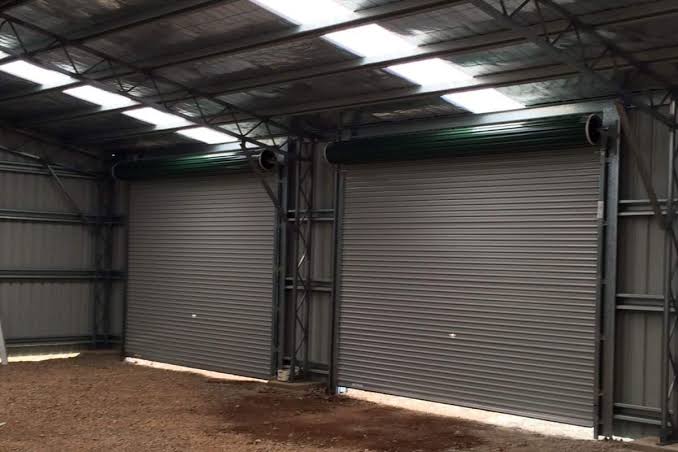
Every morning across Nairobi, thousands of shop owners heave steel shutters up by hand. Every evening, they pull them back down. It works, but it is slow, physically demanding, and hard on the shutter itself. Roller shutter door automation changes that routine entirely. One press of a remote, and the door glides open. This guide explains how shutter automation works, what the system includes, and how to choose the right setup for your premises in Kenya.
What Is Roller Shutter Door Automation?
Roller shutter door automation is the process of fitting an electric motor and control system to a roller shutter door. Instead of lifting the curtain manually, the motor turns the shutter shaft and raises or lowers the door on command. The command can come from a remote control, a wall-mounted push button, a keypad, or even a phone.
A complete automation system has four core parts. First, the motor provides the lifting force. Second, the control unit receives commands and drives the motor. Third, limit switches tell the curtain exactly where to stop at the top and bottom. Finally, safety devices such as an anti-fall brake and optional photocells protect people and property below the door.
Importantly, automation rarely requires a new door. In most cases, the motor retrofits onto the existing shutter shaft. Therefore, a shop or warehouse can upgrade without replacing the curtain, guides, or barrel.
How the System Works Day to Day
Operation is straightforward. Press the Up button, and the motor winds the curtain onto the barrel until the upper limit stops it. Press Down, and the curtain lowers until the bottom slat meets the floor. The limit switches are calibrated during installation, so the door never over-travels or slams.
During a power cut, the door does not become a problem. Every roller shutter door automation kit includes a manual override, usually a hand chain or crank lever on the motor. As a result, staff can still open or close the shutter by hand. For premises that need powered operation during KPLC outages, DC motor kits with a built-in backup battery are available. These typically allow around 20 open-close cycles on battery power alone, which comfortably covers a normal outage window.
Central Motors vs Tubular Motors
Choosing between the two main drive types is the first decision in any shutter automation project.
Central (side) motors bolt onto the end of the shutter shaft. They are the workhorses of commercial and industrial automation. Lifting capacities generally run from 300 kg up to 1,000 kg, with single-phase models for typical shopfronts and three-phase models for wide warehouse doors. Because the motor sits beside the barrel, servicing is easy and the gear reduction handles heavy curtains without strain.
Tubular motors, by contrast, slide inside the roller barrel itself. Nothing is visible once installed. They suit lighter residential shutters, garage doors, and shopfront grilles where a clean appearance matters. Capacity is lower than a central motor, so accurate curtain weight assessment is essential before choosing this route.
In short: heavy commercial door, central motor. Light residential or shopfront shutter, tubular motor. A professional site survey confirms the match.
Safety Features That Matter
Motorising a heavy steel curtain introduces risk if done casually. Consequently, proper roller shutter door automation builds safety into the hardware rather than treating it as an accessory.
- Anti-fall brake — A mechanical brake locks the shaft the moment the drive fails. The curtain cannot free-fall onto people, vehicles, or stock.
- Thermal overheat protection — If the motor winding overheats, power cuts automatically and restores once the motor cools. This protects against burnout during repeated cycling.
- Adjustable limit switches — Precise upper and lower stop points prevent the curtain from crashing into the floor or winding too far into the box.
- Optional photocells and safety edges — An infrared beam or pressure-sensitive edge stops and reverses the door instantly when something is in its path. These are strongly recommended for doors above public walkways and busy loading bays.
Additionally, modern remote transmitters use rolling-code technology. The code changes with every press, so the signal cannot be captured and cloned. For banks, forex bureaus, and cash-handling premises in Nairobi, that detail alone justifies the upgrade from older fixed-code systems.
Why Kenyan Businesses Are Automating Their Shutters
Several practical pressures drive the shift toward roller shutter door automation across Kenya.
Speed and convenience. A motorised shutter opens in seconds. For supermarkets and retail chains opening multiple branches each morning, minutes saved per door add up quickly.
Reduced wear and injury. Manual lifting strains both the shutter and the person lifting it. Curtains that are yanked up unevenly wear their guides and slats prematurely. A motor lifts smoothly and evenly, extending the door’s service life. It also removes a genuine back-injury risk for staff.
Better security. An automated shutter closes fully and locks under motor tension every time. Furthermore, integration with access control means the door only responds to authorised users, and GSM controllers add remote operation and status alerts by phone.
Power resilience. Between manual overrides and battery-backup DC kits, automation systems are designed around the reality of intermittent power. A shutter that works during an outage is not a luxury in Kenya; it is a basic requirement, and the technology accounts for it.
Choosing the Right System for Your Premises
Match the system to the door, not the other way around. These are the questions a proper assessment answers before any hardware is ordered:
- How heavy is the curtain? Curtain weight determines motor capacity. Undersized motors overheat and fail early; the correct rating runs cool for years.
- How many cycles per day? A residential garage door cycles a handful of times daily. A warehouse loading door may cycle dozens of times. Duty cycle affects motor selection because shutter motors are short-duty devices, rated for limited continuous running.
- Single-phase or three-phase supply? Most shops run single-phase 220–240 V. Industrial sites with three-phase supply can use higher-capacity motors for wide, heavy doors.
- What should trigger the door? Remote only, or keypad, RFID card, biometric reader, and GSM as well? Planning integration early avoids rewiring later.
- Is battery backup needed? Premises that must trade through outages should specify a DC kit with built-in battery from the start.
Installation and Maintenance in Nairobi and Beyond
Professional installation covers motor mounting, limit switch calibration, remote pairing, safety device wiring, and full operational testing. Proftech Kenya carries out roller shutter door automation installations across Nairobi and countrywide, including retrofits onto existing shutters and complete new-door projects.
After installation, light maintenance keeps the system dependable. Guides should stay free of dust and debris, which matters during Nairobi’s dry, dusty months. Limits should be checked periodically, and safety devices tested. A scheduled service visit once or twice a year is usually sufficient for a commercial door.
Final Thoughts
Roller shutter door automation is a practical upgrade with a clear payoff: faster opening, longer shutter life, stronger security, and safer operation for staff. Because most systems retrofit onto existing doors, the barrier to entry is lower than many business owners expect. Whether it is a single shopfront in the CBD, a residential garage in Karen, or a row of warehouse doors along Mombasa Road, there is a motor and control setup sized for the job.
Ready to automate your shutter? Contact Proftech Kenya for a site assessment, motor sizing, and professional installation anywhere in Kenya.