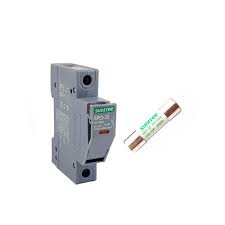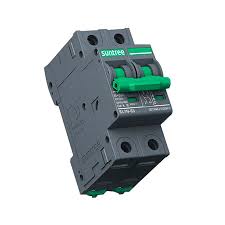
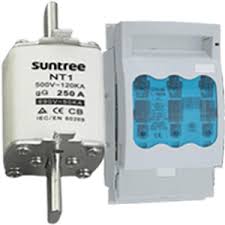
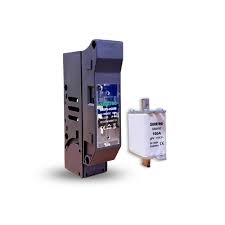
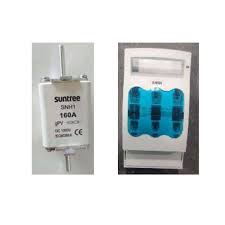
Suntree NH1 150A 1000VDC Battery Fuse – Fuselink, Fusebase and Cover (Three Pole)
The Suntree NH1 is a 150A 1000V DC blade-type battery fuse assembly designed for high-current overcurrent and short-circuit protection in solar energy storage systems, battery banks, and large off-grid inverter installations. It is supplied as a complete three-pole kit comprising three matched fuselinks, a three-pole fusebase, and a protective insulating cover — a fully self-contained DC fuse station ready for installation without additional components.
The NH1 format is a physically larger blade-type fuse than the NH00, standardised under IEC 60269-2 and DIN 43620. Where the NH00 handles currents up to 160A, the NH1 format steps up to serve the 150A–250A range — the current territory of commercial-grade hybrid inverters, large lithium battery banks, and multi-string DC busbars operating at 48V, 96V, or higher voltages. At 150A and 1000V DC, the Suntree NH1 is the correct protection specification for inverters in the 7.2kW–14.4kW range at 48V DC, and proportionally higher power levels at 96V or 120V DC battery bus voltages.
The three-pole configuration is the defining feature of this product relative to the single-pole NH00 and single-pole NH1 variants also available in the Suntree range. A three-pole fusebase houses three independent fuselinks — allowing both the positive and negative DC conductors of a battery bank, plus an additional string or parallel feed, to be fused at a single mounting point. This configuration is common in three-battery-string parallel systems and in installations where both poles of the DC circuit require individual overcurrent protection.
NH1 Format — Larger Body, Higher Current Capacity
The NH1 fuse link is physically larger than the NH00 in body length, blade contact width, and overall cross-section. This increased physical size accommodates the larger silver fuse element cross-section required to carry 150A continuously without excessive temperature rise, while simultaneously providing the greater arc-extinguishing volume needed to safely interrupt high-energy DC fault currents at 1000V.
The blade contacts of the NH1 are sized exclusively for NH1 fuse bases. NH00 and NH1 bases are not interchangeable — the different blade dimensions prevent incorrect installation between the two sizes, which is an important safety feature in field conditions where multiple NH fuse sizes may be present in the same installation.
The Suntree NH1 fuselink is constructed with a silver or silver-alloy blade element inside a high-strength ceramic body packed with chemically processed high-purity quartz sand. This is the same construction principle used throughout the Suntree DC fuse range, scaled to the physical demands of the NH1 format. The quartz sand arc medium suppresses and absorbs the DC arc that forms when the element melts under fault conditions, preventing arc re-ignition across the full 1000V DC operating voltage. The NH1’s short-circuit breaking capacity is 50,000A (50kA) at 1000V DC, confirming it can safely interrupt the high prospective fault currents generated by large lithium battery banks during a low-impedance short circuit.
Three-Pole Configuration — When and Why It Matters
A three-pole fuse assembly places three independent NH1 fuselinks — one per pole — in a single base unit. Each pole has its own fuse element, operates independently, and must be replaced individually after a fault. The three poles share a common base frame and insulating cover but are electrically isolated from each other within the assembly.
The three-pole configuration is used in the following scenarios:
- Three-battery-string parallel systems — where each positive string conductor requires its own overcurrent protection before the strings are connected to a common busbar. One NH1 per string prevents a fault in one string from drawing destructive reverse current from the remaining two healthy strings.
- Positive and negative pole fusing — some installation standards and inverter manufacturers recommend fusing both the positive and negative DC conductors of a battery bank. A three-pole base fuses both poles with a third pole available for an additional parallel string or sub-feed.
- Multi-input DC distribution boards — where two or three high-current DC feeds arrive at a distribution point from separate battery banks or PV arrays, and each feed requires independent overcurrent protection.
In all these scenarios, the three-pole NH1 provides the same protection as three separate single-pole assemblies in one third of the panel space. This compactness matters inside battery cabinet enclosures and DC distribution boards where physical space is limited.
The Complete Three-Pole Kit: Fuselink, Fusebase and Cover
Each of the three components in the kit has a specific and non-interchangeable role:
Fuselinks (×3) — the three individual sacrificial overcurrent elements, one per pole. Each fuselink contains the silver blade element, ceramic body, and quartz sand medium. They are one-time use components: after operation under a fault condition, the blown fuselink must be replaced with a new one of the same current rating. The NH1 fuselink dimensions comply with DIN 43620 / IEC 60269-2, meaning Suntree fuselinks are physically interchangeable with NH1-format fuselinks from other IEC-compliant manufacturers.
Fusebase (three-pole) — the permanent wiring termination frame housing all three pole positions. Each pole position has a screw-terminal cable connection point and spring-clip blade contacts that retain the fuselink. The base is fixed to the panel or enclosure backplate during installation and is not removed after faults — only the fuselinks are swapped. The three-pole base positions the three fuse poles in a row, with internal phase barriers between poles providing isolation between adjacent live conductors.
Protective insulating cover — the shroud that fits over the complete three-pole assembly after installation. The cover prevents accidental contact with the fuselink blade contacts and base terminals during normal operation. At 1000V DC and 150A, uninuslated live parts present a serious electrical hazard; the cover makes the assembly touch-safe for personnel working inside the enclosure.
Sizing Guidance for the 150A NH1
The 150A rating makes the Suntree NH1 150A the appropriate fuse for DC circuits where continuous current falls between approximately 120A and 150A. In practical solar and battery system terms:
- At 48V DC bus voltage, 150A continuous corresponds to approximately 7.2kW — covering inverters rated 5kW–7kW with headroom for surge currents
- At 96V DC bus voltage, 150A corresponds to approximately 14.4kW — appropriate for commercial off-grid systems and large hybrid battery installations
- For battery string fusing, IEC guidance recommends fusing at 1.25× the maximum continuous discharge current of the string. A 150A fuse is therefore appropriate for battery strings with continuous discharge ratings up to approximately 120A
The NH1 series is available from Suntree at 150A, 160A, 200A, and 250A within the NH1 format. The 150A is the entry rating for this size and is the most commonly specified in residential-to-light-commercial solar systems using 48V or 96V battery architectures